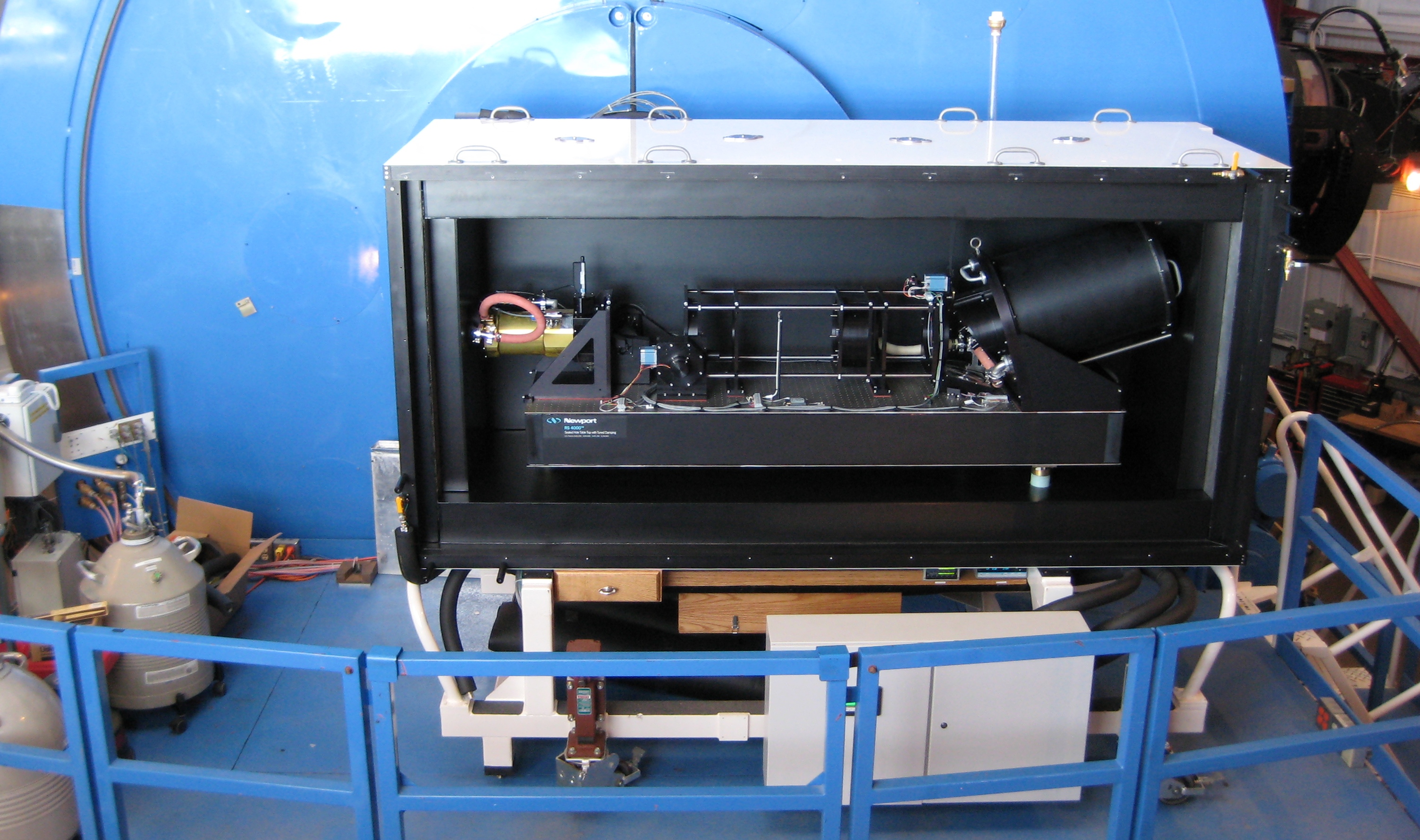
 The Carnegie Planet Finder Spectrograph (PFS) is hard at work searching for
extrasolar planets with the the 6.5 meter Magellan II Telescope at
Las Campanas Observatory in Chile. It detects exoplanets through their
gravitational influence on their host stars, which cause Doppler
shifts in the stellar spectra that can be measured to give the stellar
velocities to a precision better than 1 meter per second. As the planets orbit
their hosts, the measured stellar velocities vary periodically,
revealing the planetary presence and information about their masses and
orbits.
The Carnegie Planet Finder Spectrograph (PFS) is hard at work searching for
extrasolar planets with the the 6.5 meter Magellan II Telescope at
Las Campanas Observatory in Chile. It detects exoplanets through their
gravitational influence on their host stars, which cause Doppler
shifts in the stellar spectra that can be measured to give the stellar
velocities to a precision better than 1 meter per second. As the planets orbit
their hosts, the measured stellar velocities vary periodically,
revealing the planetary presence and information about their masses and
orbits.
PFS is a high resolution, optical echelle spectrograph that covers
wavelengths from 391 to 734 nm with resolving powers from 38,000 to 190,000.
The high efficiency optical design includes all spherical, standard optical
glass and calcium fluoride lenses that function as both camera and
collimator in a double-pass configuration that allows the R4 grating to be
illuminated in a near-Littrow configuration. A prism is used for
cross-dispersion. A molecular iodine absorption cell is used to superimpose
well-defined absorption features onto the stellar spectra to aid with point
spread function deconvolution and wavelength calibration. PFS has been in
scientific operation since 1 January 2010.
PFS is a PI instrument and is only available via collaborative arrangement
with the instrument team. If you are interested in using PFS, contact Steve
Shectman before submitting a proposal.
Questions about the instrument may be directed to Jeff Crane. Questions
about PFS exoplanet science may be directed to Paul Butler.
PI team:
Paul Butler,
Jeff Crane,
Steve Shectman,
Ian Thompson
Publications citing Crane et al. 2010: ADS
|